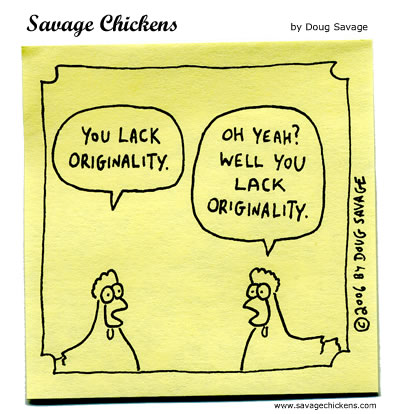
Bruce Springsteen on Creativity

Wednesday, June 13, 2012

This year, Bruce Springsteen was the keynote speaker at the Austin music festival, South by Southwest (SXSW), and delivered a great talk about the evolution of music in his lifetime.

What really resonated with me was when he talked about authenticity:
"The genesis and power of creativity... it's all about how you're putting what you do together. The elements don't matter. The purity of human expression and experience is not confined to guitars, to tubes, to turntables, to microchips. There is no right way, no pure way, of doing it. There's just doing it.

We live in a post-authentic world. Today authenticity is a house of mirrors. It's all just what you're bringing when the lights go down. It's your teachers, your influences, your personal history. And at the
end of the day, it's the power and purpose of (your music) that still matters."

I love this sentiment. Truly. I would argue there is nearly always a pure or authentic way to do things. Inasmuch as we have access to the source material, anyone who is moved to re-create what was can take that knowledge and do so; and I think that is an amazing and beautiful art and skill in and of itself. But not everyone desires to re-create, not every desires to emulate, not everyone desires to preserve. Some are more motivated by creating something new, using various influences and inspirations from these original sources (or not!).

Some artists are more interested in the intersection of multiple influences--whether it is an exploration of their similarities, or highlighting the contrasts of their differences, there is room for all these approaches to art and creativity. So long as we are honest about what we are creating, there is a place for everything and everyone in the pursuit of our art.

Ideally, we do our creating with understanding of the Root of what we are doing. Rather than just grabbing this and that and shoving them together, instead really digging into the nuance of the material, and making a conscious choice about the creative decisions we arrive at makes for the very best performances. It is by understanding what came before us that we are best prepared to push the envelope and evolve gracefully into the future.

So which are you? Do you prefer to re-create the source? Or innovate and remix? Neither one is better than the other, it's all about what moves you...

See the whole fabulous speech here:

Authenticity requires context

Tuesday, April 24, 2012

"I think that we get squeamish about using the term "American" because we are concerned with authenticity. I do believe that it's important to study and respect the dances that came before us and label what we do appropriately. However, I think that when we stress too much about being "authentic", we forget what authenticity really means.

I read an article in Saveur magazine a few years ago that changed the way I think of that term. It talked about how people were going to great lengths to recreate the earliest known recipes for ravioli. In their quest for authenticity, they were ordering game and organ meats from specialty vendors on the other side of the country. They got the details right, but lost the spirit of the dish: ravioli was a thrifty food, what you made with the scraps you had left over from other dishes. The point of the article was that authenticity is meaningless without context."

jmdruadh on Bhuz

This quote really gave me some great food for thought about our definition of authenticity in the dance. When the dances we do today were first conceived, what was the context in which it was created? Why did they move the way they did, address the music the way they did...it's really worth thinking about. Because it can better guide us in making decisions about our adaptations or fusions which really get at the heart of the original form we are building on.

Why Yes, I am a Bellydancer.

Friday, October 28, 2011

I know quite a few dancers who are not on Facebook, where this was making the rounds a couple months back. Thought I would post it here for those who haven't seen it. And dammit, it's funny every time. And sadly familiar. But funny!

Maybe it will inspire a few Halloween costumes this weekend...

Steampunk Bellydance - an article and some thoughts

Monday, February 28, 2011

 On a discussion over in the comments section on this article on Gilded Serpent, there is some debate about whether Steampunk Bellydance is a legitimate genre of dance or not--the article asserts it is not, and some commenters argue the contrary.

One very articulate poster, going only by the name "T.", is clearly a Steampunk practitioner/enthusiast/community member, and had some very articulate thoughts to share on her frustrations with the overuse of Steampunk in everyday parlance.  A portion of her post read:


"It’s never a good feeling, having your meticulous, time-honored craft dismissed or eclipsed by a trend you have no immediate connection to. It’s difficult not to feel uneasy, watching your art form be oversimplified, lumped in, or lazily dismissed by an all-too-easy and reductive definition. It’s not fun, being shoved in a box that you have no desire to be in, even if that box is comfortable, or even inspiring, for plenty of others who’ve willingly placed themselves inside of it."

My reply, which I share as a founding member of the Seattle Steamrats in addition to my over a decade of teaching and performing bellydance, are as follows follows:

On "the Bellydance Police"

Sunday, January 9, 2011

On Shira's tribe over on tribe.net (no, tribe isn't dead!), she referenced an article on Gilded Serpent in which another dancer wrote with a fair amount of disdain about those who rally behind the idea of retaining historical and cultural elements of bellydance (what is often termed "The Bellydance Police"). You can see the discussion, and link to the article, HERE. Shira follows it up with a great analogy, which I thought would be nice to share over here. So without further ado, I give you Shira's take:

"Let's say I write a 17-line poem with each line containing somewhere between 8 and 34 syllables and call it haiku. Now, the "poetry police" killjoys would tell you that such a poem does not conform to the properties of haiku (3 lines in length, with 5 syllables in line 1, 7 syllables in line 2, 5 syllables in line 3) and therefore is not haiku. Now, this poem may well convey my vision, my passion, my joy, and a completeness in my quest for beauty. These things would certainly qualify it as "poetry", but they don't qualify it as haiku.

But if I enter that poem in a haiku writing contest, should I expect to win? Should I expect journals that specialize in haiku to publish it, simply because I have chosen to declare that it is haiku, even though it does not contain the properties that people well-versed in the form would recognize as haiku?

If I start teaching classes in how to write haiku, should it be okay that I encourage my students to write any poem of any structure they please, all in the name of their vision, their passion, their joy, and a completeness in their quest for beauty while still calling the end result haiku?

I would argue that no, it may all still be POETRY, and it all may all be worthy of being read, but there is a certain basic set of properties that must be met before you identify it as a specific genre of poetry. It still deserves to be written, and shared if the poet wishes to share it, but ultimately there should be truth in labeling."

ATS - The new definition from Carolena

Thursday, September 16, 2010

At about 5pm this evening, Carolena has officially expanded her definition of ATS. Here is the latter portion of her announcement this evening. I would love to hear what you think.

"There is still some confusion about what is ATS and what is any variety of Tribal, but that's OK. We have Sister Studios, teachers that adhere to the philosophy of FatChanceBellyDance in their ATS classes, 98 at the time of this writing. We have TribalStar Galactica, my attempt in getting all the "tribes" together in one place, no matter of the genre, 247 at the time of this letter.

It's finally time for me to give the gift that I had intended at the filming of Dance Fundamentals-be creative and have fun.


There are so many new steps and concepts being presented to me that I feel the need to broaden our definition of ATS. I propose that the steps from Tribal Basics Vol. 1 Dance Fundamentals and Tribal Basics Vol. 4 Embellishments and Variations be considered ATS Old School, as they are the foundation of what we do. Everything else, including our Tribal Basics Vol. 7 Creative Steps and Combinations, are to be considered ATS New Style.

Rachel Brice on Tribal Fusion

Gotta love it:

"There are very few rules in Tribal Fusion, but in my humble opinion the one constant is that the dancer or group is versed in American Tribal Style as taught by Carolena Nericcio. Her stylistic approach to existing vocabulary, her theatrical approach to costuming, and the incredible invention of group improvisation, has allowed infinite variations that all have one thing in common: powerful presentation. The strength that American Tribal Style communicates through its posture, arm placement, and costuming was a revelation for me as a feminist. Without Fat Chance, I can honestly say I wouldn’t be dancing today."

-Rachel Brice
Full article below

More on music: Traditional music opens you up...

Wednesday, September 8, 2010

Expanding on the "Does Music Make the Dancer" post the other day, fellow dancer and student, Meissa, posted this on the Shira.net tribe earlier this year:

"I have been told "you can bellydance to anything you want" more times than I can count True, but, I also crashed and burned so very hard on my last solo of 2009 (which was a total trainwreck and a huge pain to watch-I can't believe I subjected people to THAT kind of self-indulgence), and preparing my first solo of 2010, cause I didn't learn from my 2009 mistake.  

I was so hellbent on dancing to that obscure music no one had danced to before, and putting on that pretty costume that no one else had, that I forgot what I really wanted to do: BELLYDANCE.

I was so very proud of myself when I danced solo to a traditional piece for the first time. I forgot about all the trinketry and the jewelry and just allowed myself to open up and feel the music."

I simply adored these sentiments from Meissa!

"Everything Your Mother Should Have Told You About Being An Artist"

Friday, July 24, 2009


From http://www.artadvice.com/advice/article30.php

"No matter how original you think your work is, it has been done before.

Originality does not define quality, quality defines quality. Regardless of whether or not your work is original, what makes art exceptional is the context in which it was made from an art historical point of view. Study art history, know your influences, and understand that originality and/or technique is only one of many considerations in the determination of what makes art great."

YES! I really loved this quote from the article, as it says so much about what I feel about our dance world. So many dancers are struggling and pushing to be "uber-original"--everyone seems to want to lay claim to being "first" at whatever new trend might hit the scene. But this grasping does not create authentic, organic work, and it does not guarantee any quality of the end product.

I always say I would rather see three of the "same old" moves executed amazingly well than 15 "new things" done sloppily. Hey, I love to see new work--it can inspire! But more invigorating to me is seeing a performer with real chops doing something from a deep source of understanding and love of the material than someone who is trying to throw 15 tricks into 15 seconds.

While this article addresses painters/sculpters/etc, it is an interesting read for anyone who has the dream of being An Artist. Read on...

Tribal Style: Getting our Terms Straight

Wednesday, July 1, 2009

More blasts from the past today! After I found that old class outline, I also found a repository of some of my old articles from various publications.

Below is an article I wrote for the now-defunct Caravan Trails quarterly newsletter which used to be produced by Paulette Rees-Denis of Gypsy Caravan. I was author of a regular column called "Of the Tribe" for a short time, for which I wrote short articles focused on the topic Paulette had chosen. This was for my first article, sometime in 2001, or maybe early 2002. Enjoy a little retro reading...

Modern media kills the organic process?

Saturday, May 30, 2009


I recently had a discussion with Read My Hips' director Stephanie Barto about the effect of the internet and on-demand media on the natural organic progression of art. I think performance art struggles in particular in the new millenium, victim of the "glazed over eyes after 60 seconds" and "that was so 5 minutes ago" attitudes, in a way that visual art does not.


Here is a snippet of what she shared (which is in part a discussion she was having with another dancer), and my thoughts in return:

Dancer A: "The internet has so much influence over the spread of tribal belly dance. I wonder if the internet just kills everything because it doesn't let it grow naturally."

SB: "It's also interesting how tribal bellydance in the days before social
networking and YouTube was a much smaller world, and did tend to evolve in a more organic ways. (My troupe) is an example ... I started with Carolena's foundation, and the ways I changed it were all about making it more "me" and/or being inspired by the skills of the people I was working with. What I arrived at felt honest, even if it wasn't anything shockingly innovative or spectacular in the big scheme of things."

My response to these observations after the jump.

Honesty in dancing...a RLJ

Tuesday, April 21, 2009

Can someone Re-LiveJounral, like we ReTweet? And can we RLJ ourselves?

I am building up some content over here on Blogger, and thought I would grab some recent posts from my LiveJournal that might be of interest here, where I plan to talk mostly about dance (that is the PLAN anyway). So here it is:

Asharah posted in her journal last year about "honesty" in dancing. And it just got me postin', so I thought I would post a bit over here.

I see a lot of contrived performances--in aesthetic and execution. I see a lot of inauthentic dancers. Dancers who are not being their authentic selves on stage. They are clawing and grasping at trying to be or do the next big thing. I remember one gal at a workshop I taught not too long ago saying she was going to take a hula class because she was excited about the possibilities of fusing it with her bellydance, but then she found out Unmata was already pretty famous for that, so she was going to try and find something else to study to fuse. I was stunned into silence.


Web site created by: Hey Shay Designs
aka 'She teaches, she dances, she designs!'